
🔹 Introduction
Time is our most valuable resource, yet it’s often wasted the most. Whether you’re a student, a working professional, or someone juggling multiple responsibilities, mastering smart time management strategies can transform your daily routine and productivity.
In this post, you’ll discover practical, actionable, and realistic strategies that anyone can implement — even if you’re starting from scratch.
Table of Contents
⏰ 1. Understand Where Your Time Goes
Before you can manage your time, you need to know where it’s going. Start by tracking your activities for 2-3 days.
- Are you spending too much time on social media?
- Is your work time filled with distractions?
- Are you jumping between tasks?
This self-awareness is the first step in developing smart time management strategies that actually work.
🗓 2. Create a Realistic Daily Plan
Planning your day doesn’t mean filling every minute. It means prioritizing what actually matters.
✅ Use the 80/20 Rule: 80% of results come from 20% of efforts.
✅ Set 3 key tasks for the day — not 10.
✅ Leave time for breaks and unexpected events.
Smart time management strategies focus on creating balance, not burnout.
🎯 3. Set Clear Goals with Deadlines
A goal without a deadline is just a dream. Break your big goals into small tasks and assign a timeline.
For example:
- “I will complete my science project by Sunday.”
- “I will study 2 chapters of Math today.”
SMART goals (Specific, Measurable, Achievable, Relevant, Time-bound) are a core part of smart time management strategies.
📴 4. Eliminate Distractions
One major reason people fail at managing time is distraction.
Here’s how to reduce them:
- Turn off unnecessary notifications.
- Use “Focus Mode” on your phone.
- Study/work in a clean, quiet space.
Minimizing distractions helps in applying smart time management strategies effectively.
⏳ 5. Use the Pomodoro Technique
This technique is a game-changer.
🟢 Work for 25 minutes
🔴 Take a 5-minute break
Repeat this cycle 4 times, then take a longer break (15–20 minutes).
It improves focus and avoids burnout — the core of smart time management strategies for students and professionals.
🧠 6. Prioritize According to Energy Levels
We all have high-energy and low-energy times during the day. Identify your peak hours and schedule your hardest tasks then.
- High-energy → Do complex work (like writing, problem-solving)
- Low-energy → Do easy work (like email, review, organizing)
Smart time management strategies work best when aligned with your natural rhythm.
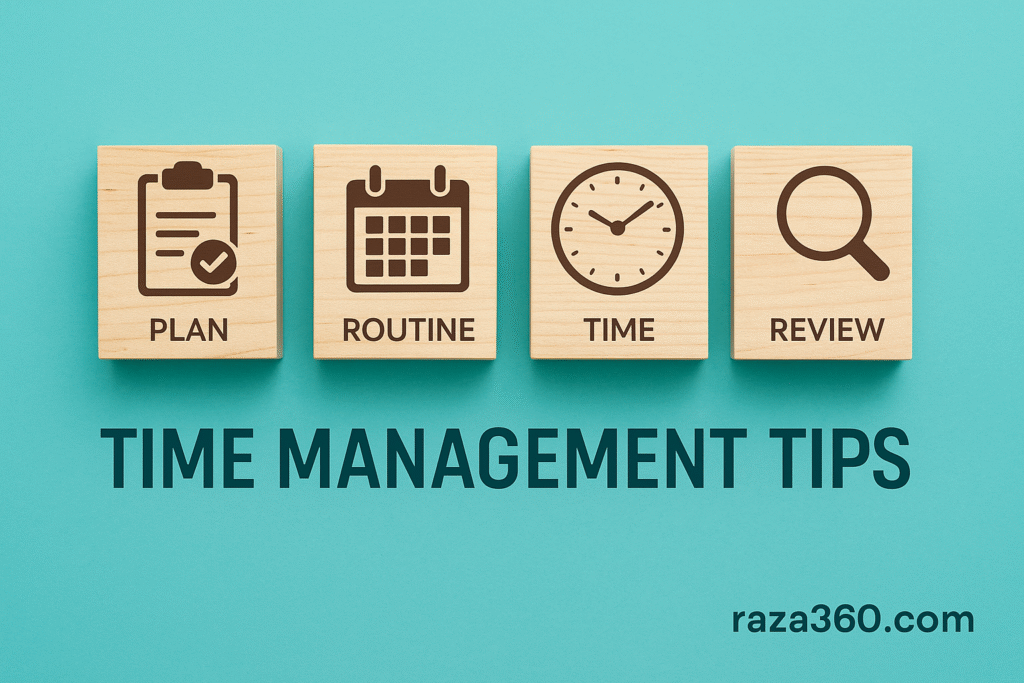
🔁 7. Review and Reflect Weekly
At the end of the week, review:
- What worked well?
- What caused delays?
- What should you change?
Reflection helps refine your routine and strengthens your smart time management strategies.
📚 8. Apply These Tips to Study & Work
For students:
- Plan your study sessions based on syllabus and exam dates.
- Make subject-wise mini-goals.
- Avoid multitasking during learning.
For professionals:
- Use calendar blocks for tasks.
- Say “no” to tasks that aren’t priority.
- Follow a morning routine to start strong.
Whether for school or work, these smart time management strategies can drastically boost productivity.
😌 9. Add Time for Rest and Recharge
Don’t forget this!
A tired brain can’t be productive. Add at least 30–60 minutes daily for:
- Walking
- Meditating
- Hobbies or light reading
Healthy minds use smart time management strategies not just to do more, but to feel better too.
🔟 Bonus Tools to Try:
Try these apps for better time management:
- Trello – for task boards
- Google Calendar – for scheduling
- Forest App – stay focused
- Notion – plan your week/month
These support your smart time management strategies with tech assistance.
🎁 Final Thoughts
Don’t try to become a time management expert overnight. Start small. Pick 2–3 strategies from this list and stick to them. Within a week or two, you’ll feel more in control, less stressed, and more accomplished.
✨ Remember: It’s not about being busy. It’s about being effective. Mastering smart time management strategies can unlock more free time, better focus, and a more balanced life.
👉 Prefer reading this post in Hindi? Click here